


Berry sets out Reform’s early deregulation agenda
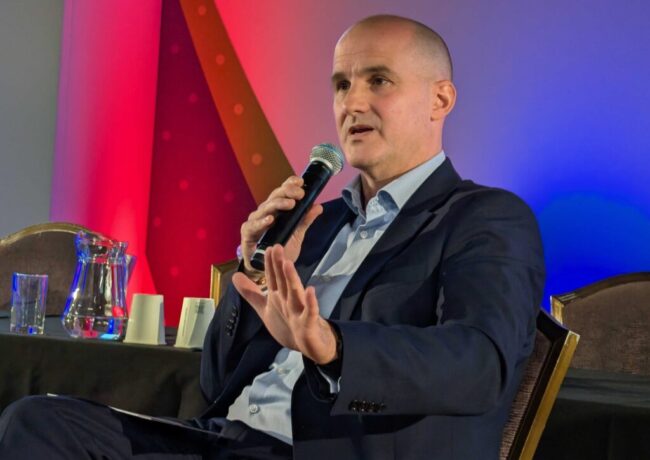
Reform’s Jake Berry says the party is “not wedded to ideology” as it draws up its new policy platform, adding that deregulation, devolution and delivery could form the basis of the party’s general election manifesto in three years.
As part of a pitch to business at the three-day UKREiiF event in Leeds this week, he said Reform would likely roll back industry regulation it deemed unnecessary in a bid to get the country building again, citing HS2 as an example of a project where planning regulations has obstructed progress.
His comments were made against a wider backdrop of frustration at the conference, where developers, local authorities and investors had repeatedly emphasised delays in delivery pipelines, rising build costs and the cumulative impact of planning on viability.
“The government, whether thats local government or national government, and the courts through things like judicial review, is a significant clog on people’s ability to deliver,” he said.
“The Reform government is developing its policy, this is what Richard Tice is talking about and developing, and will have a plan to roll back all of those unnecessary [regulations]. We’ve got to have some regulations, I appreciate that, we don’t want to see a wholesale abolition of the environmental protections that we all know, love and enjoy in this country.
“But you have to focus on the bigger prize of getting the UK economy going, and that’s what Reform will be doing.”
Off the back of a successful local election campaign for the party this month, former Conservative party chairman Berry, who defected to Reform last year, said the party was developing a “solutions-driven” policy platform for a general election.
In a bid to illustrate the point, he added that they could potentially go as far as supporting traditionally left wing positions such as rail nationalisation, if they deemed it was the right thing to do to improve services.
He also hinted the party could go further on the transfer of powers to regions across the UK, saying it was his “personal view” that devolution currently does not go far enough.
However he said mayors should be more accountable for local spending, and should pay for local schemes through area-specific levies rather than through general taxation.
“Devolution will have only truly succeeded when it’s combined with local taxation,” he added.
“One of the things I was trying to push when I was in government was that every area should have a devo-max option, so if Manchester has the power to try and improve systems in the NHS, why shouldn’t Teeside, why shouldn’t West Yorkshire have it, why shouldn’t the North East have it?
“If devolution is really going to succeed, Mayors truly need to be held account for the decisions that they make. Money spent like that should be raised locally, mayors should be held accountable for it. Of all the powers that Andy Burnham has, the one he has never used is the ability to raise taxes locally – he has the right to [create] a business levy in Greater Manchester to pay for things like infrastructure.
“The question I put to Andy is why not? I think it’s because it’s politically unpopular.”
He also told delegates the UK should look at fracking and North Sea oil to reduce its dependence on the international energy market.
North Sea oil and gas production boomed in the 1980’s, but official government statistics say around 93% of the oil and gas that is likely to be produced from the North Sea has already been extracted.
“As a new party you have to get new policy areas, kind of everywhere. If someone said to me ‘What was Reform’s policy when it came to planning or infrastructure and growth five or six years ago, or two elections ago, I can say well it didn’t exist.
“That’s a huge challenge for Reform, but it’s also the greatest of opportunities and a particular opportunity for business.”