



Tees Valley’s dual growth strategy | Q&A with Matt Johnson
Place North East caught up with the director of Teesworks and Wynyard Park to discuss how industrial regeneration and placemaking are shaping a new era of growth across the region – from a nationally significant industrial hub attracting up to £5bn in private investment to one of the North East’s most established residential communities.
Teesworks is regenerating 4,500 acres of brownfield land on a former steelworks into an industrial zone, while across the River Tees Wynyard Garden Village is planning to deliver around 6,800 homes in total as part of a government-backed programme. How do you develop both heavy industry and place-making, and make sure both ventures bring equal value to a region?
Around £560m of public money had been committed to the Teesworks redevelopment by 2024/25, according to the government’s independent review, with hundreds of millions more potentially planned. In addition, Teesworks says the site has attracted between £2-£5bn in private investment linked to major industrial projects moving onto the former Redcar steelworks site.
Unlike Teesworks, Wynyard Park is privately funded, with cumulative investment across its various phases, with housing and retail space brought forward by developers such as Castle, Duchy Homes, Stonebridge, Cameron Hall, and Robertson Homes.
Teesworks is now six years into its transformation journey. Looking back, what have been the defining milestones that shifted the site from former steelworks land into one of the UK’s flagship regeneration projects?
The defining milestones have been the pace of delivery, the strength of collaboration across the public and private sectors, and our ability to secure billions of pounds of multinational investment into the region.
The scale of demolition, remediation and infrastructure delivery has transformed what was once a dormant former steelworks site into a globally competitive industrial zone. Most importantly, we are now creating jobs and opportunities for local people again, which has always been the core objective of the project.
From a development perspective, how do the delivery models at Teesworks and Wynyard Park differ, particularly when balancing speed of investment with long-term placemaking objectives?
They operate at opposite ends of the development spectrum. Wynyard Park is fundamentally a placemaking-led scheme focused on high-quality residential and mixed-use development, with sustainability, design and community at its core.
Teesworks, by contrast, is an industrial development on a nationally significant scale. Due to the size of the estate and the nature of inward investment, projects require extensive feasibility work, planning, legal agreements, financing structures, and statutory approvals before construction can even begin. Naturally, that means delivery timescales are much longer.
Despite those differences, both developments are ultimately delivering the same outcomes – inward investment, economic growth and long-term prosperity for the region.
Teesworks is often discussed in terms of industrial scale, while Wynyard Park represents a more mixed-use, community-led growth model. How do you ensure both developments contribute to a coherent regional vision rather than operating in isolation?
Although the developments are very different in character, they are both contributing to the same wider regional ambition – creating a stronger, more resilient North East economy with opportunities for people to live, work and build careers here. Teesworks is attracting global industry, investment, and employment at scale, while Wynyard Park helps meet growing demand for high-quality housing, commercial space and community infrastructure. One supports industrial and economic growth, the other supports lifestyle, talent retention and long-term placemaking.
For the region to succeed, you need both. Major employment opportunities and high-quality places to live must develop alongside one another rather than in isolation.
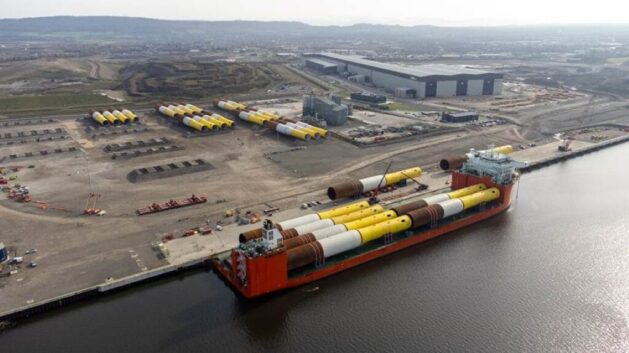
Steel River Quay at Teesworks. Credit: Cool Blue PR
What are occupiers and investors currently prioritising when considering opportunities in the North East, and how has that changed over the last five years?
The priorities today are clear – deliverability, access to power and utilities, and the availability of a skilled workforce. Over the last five years, Teesworks has created opportunities through large-scale demolition and site clearance, making development-ready land available for global
occupiers. That has enabled us to compete internationally for investment in a way the region perhaps hasn’t since the height of the steel and ICI eras.
Having the key foundations in place in terms of infrastructure, planning frameworks and utilities is critical to securing occupiers and investment projects.
Infrastructure is frequently cited as the catalyst for regional growth. Which infrastructure investments have been most critical to unlocking development momentum across both Teesworks and Wynyard Park?
At Teesworks, the Steel River Quay has been transformational – a new 450-metre deep-water quay capable of supporting major offshore wind and industrial projects. Alongside that, power infrastructure has been absolutely critical. The Steel River Power team has worked tirelessly to secure more than 1,600MVA of available power capacity, which is a major competitive advantage.
At Wynyard Park, infrastructure is less about heavy civils and more about community infrastructure – high-quality landscaping, woodland walkways, retail amenities, and creating an environment that genuinely enhances quality of life. That placemaking approach is what sustains long-term desirability.
As inward investment competition intensifies across UK regions, what advantages does the North East now offer that perhaps weren’t being recognised a decade ago?
The North East offers something increasingly rare – aside from land and infrastructure, we also have an incredibly skilled, passionate workforce with deep industrial expertise, supportive local authorities focused on economic growth, and a strong track record in manufacturing, engineering and innovation.
For a long time, those strengths perhaps weren’t recognised nationally to the extent they should have been. That perception is now changing as more global investors the capability and opportunity the region offers.
Wynyard Park has seen sustained residential and commercial demand despite wider market uncertainty. What does that tell you about changing patterns of work, living, and business location decisions in the North East?
Despite recent economic challenges, the North East remains a fantastic place to live and do business. Connectivity has improved significantly – you can be in London within two hours – while still benefiting from quality of life, strong communities, and a more balanced cost base.
There is also a growing confidence in the region. We have vibrant city centres, established businesses, exciting start-ups and a strong sense of pride in the North East. Developments like Wynyard Park reflect that confidence and continue to attract people because they offer high-quality environments in well-connected locations.
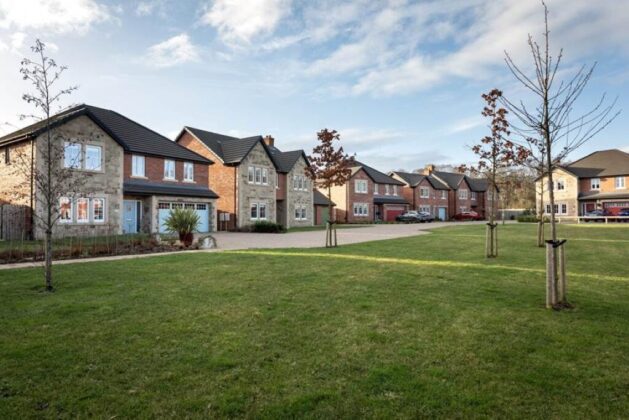
Wynyard Garden Village. Credit: Cool Blue PR
For developers and institutional investors watching Teesworks, what lessons can be learned about delivering regeneration at industrial scale?
The biggest lesson is that regeneration at this scale takes time. Projects of this complexity do not happen overnight, particularly when dealing with remediation, planning, environmental permitting, and infrastructure delivery. A huge amount of technical and preparatory work has to happen before visible development begins, and many approvals can take months or even years to secure.
We have now established much of that framework across the site, which significantly improves future delivery capability. It also demonstrates the importance of strong public-private partnerships. Government support, local authority collaboration and private sector investment all play a vital role in unlocking economic growth at scale. Naturally, projects of this profile attract scrutiny, but there also needs to be recognition that transformational regeneration requires ambition, patience and partnership working. Ultimately, delivery is what matters.
There is increasing pressure on regeneration schemes to deliver both economic impact and social value. How are Teesworks and Wynyard Park approaching skills, employment and community integration as part of their growth strategies?
Social value sits at the forefront of our strategy. Skills, employment and opportunities for local people are absolutely central to what we are trying to achieve. I’m Redcar born and bred. I remember driving past the steelworks and ICI when they were thriving industries, and I’ve also seen the impact their closure had on the town and local families. At one stage, regardless of academic background, there was always a pathway into industry – often generations of the same family worked in those sectors – and that disappeared almost overnight.
A major focus now is rebuilding those opportunities. We are working closely with TVCA, occupiers, and businesses across the site to create pathways ranging from apprenticeships through to employment opportunities for older generations who were impacted by industrial decline.
Alongside that, there are a number of community initiatives already underway, with several exciting projects hopefully coming forward soon. We also established the Teesworks Benevolent Foundation to support local causes, including food banks and a number of wider community support initiatives.
Looking ahead, where do you see the biggest development opportunities emerging across the North East over the next five to ten years, and what role will projects like Teesworks and Wynyard Park play in shaping that next chapter?
The biggest opportunities will come from sectors where the North East already has genuine competitive advantages – clean energy, advanced manufacturing, offshore wind, logistics, AI and digital industries and high-quality residential growth. The region is well-positioned to support the UK’s energy transition while also attracting new industrial investment and creating long-term skilled employment. At the same time, there will continue to be strong demand for high-quality places to live and work, particularly developments that prioritise sustainability, connectivity and community infrastructure.
Projects like Teesworks and Wynyard Park will play an important role in shaping that next chapter because together they demonstrate the breadth of opportunity the North East can offer – from globally significant industrial investment through to long-term placemaking and community growth.