



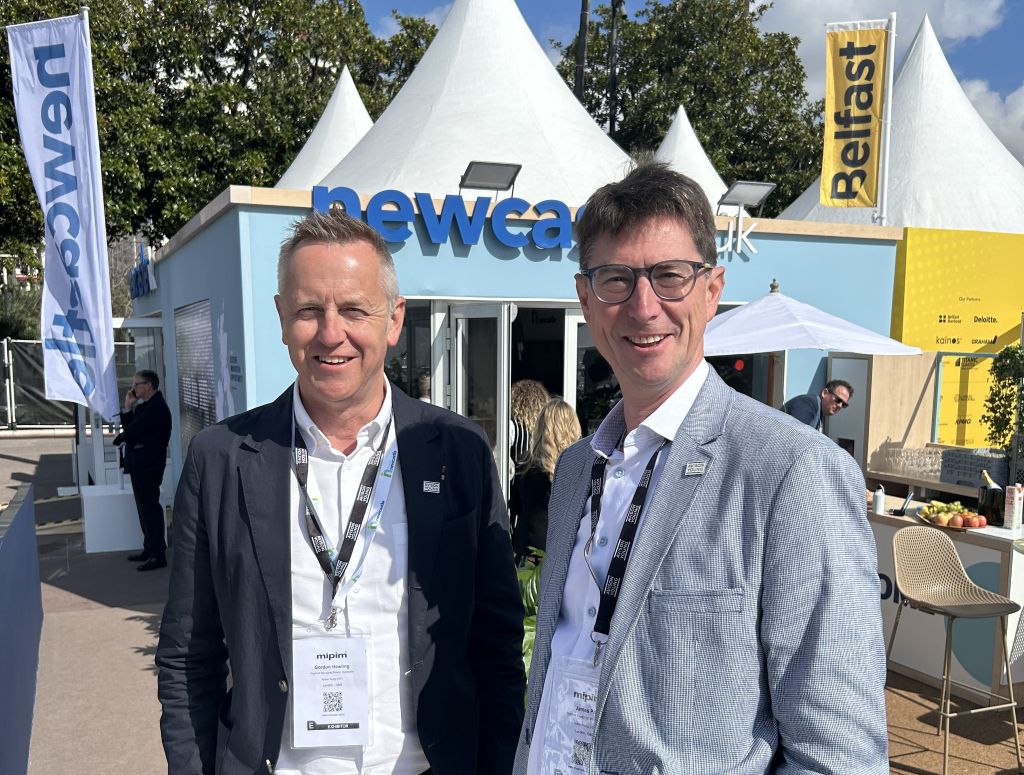
MIPIM | Q&A with Avison Young
Place North caught up with Gordon Hewling, managing director Newcastle, and James Pitt, managing director Leeds and director of development at the international property exhibition to delve into why the North’s infrastructure, energy resilience, and development pipeline are attracting growing investor interest.
What is your focus at MIPIM this year?
GH: For me, it’s about promoting the North East and talking to investors about the region’s potential. We’re involved in a number of schemes across the area, and James and I spoke yesterday about where the property market is today and where it could go over the next decade.
If you look at rental levels in Newcastle compared with somewhere like Leeds, there’s still clear headroom. The question is: why shouldn’t Newcastle get to Leeds’ levels over the next five to 10 years? The region has strong fundamentals – land availability, reliable water, and electricity supply, and the infrastructure needed to support growth.
So being here at MIPIM is about explaining that story and highlighting the opportunities.
JP: From my perspective, as part of our national Place team, the focus is slightly different. I’m looking across regions to identify common challenges and opportunities for our clients, many of whom operate nationally.
One theme we’re seeing across the country is stalled development sites. In many cases, these were set up through joint ventures or partnerships that made perfect sense when they were agreed, but the market has changed significantly. The challenge now is how those agreements can evolve so projects can adapt to the current economic environment and move forward again.
Cities across the North have focused heavily on regeneration in recent years. Where do you see the biggest opportunities emerging?
JP: One of the biggest opportunities is devolution. It’s putting funding and decision-making closer to the communities where it’s needed, which in turn helps unlock development.
It also links together major infrastructure initiatives – things like mass transit systems and rail improvements – that improve connectivity between cities. When you look at corridors between places like Liverpool, Manchester, Bradford, and Leeds, those kinds of investments have the potential to strengthen the northern economy as a whole.
These big structural interventions then create the conditions for development opportunities at a more local level.
GH: The key challenge is coordination. For public sector landowners in particular, the focus is on bringing sites forward in a way that maximises value – whether that’s for housing or commercial uses.
There’s also an interesting debate happening around what ‘best consideration’ actually means in that context. Public sector investment, whether that’s infrastructure, transport or cleaning up brownfield land, can significantly increase land value. The question is how the public sector captures a fair return over time, while still ensuring the private sector has the incentive to invest.
Ultimately it’s about finding the right balance between public and private partners so projects can be delivered and the benefits such as jobs, housing and growth are realised.
What differentiates cities that successfully attract investment from those that struggle?
JP: For me, there are three key ingredients: strong leadership, a clear vision, and a credible delivery strategy. If those things are communicated well, investors come away understanding exactly what the opportunity is and how they can get involved.
You can see that clearly when you walk around MIPIM. Some city regions present a very clear story about their ambitions and priorities.
Newcastle and Gateshead are a good example. They are presenting themselves as two closely connected urban centres, working together to deliver growth. Development on one side of the river benefits the other, particularly in areas like housing where both cities want to see more people living in the urban core.
That coordinated message is important and more broadly, I’d like to see even stronger collaboration between northern regions. Together they could present a very powerful proposition internationally.
What message resonates most with international investors when you talk about the North?
JP: One of the realities at MIPIM is that cities across the UK are competing with the rest of Europe for investment capital.
I was speaking yesterday with a major international fund that raised a significant amount of capital last year and is now looking to deploy it, particularly into the living sector. Investors like that are looking across multiple countries and cities.
So the challenge is making a compelling case for the UK, and then for individual regional markets within it.
GH: There are some big macro trends that actually play to the North East region’s strengths. For example, new shipping routes emerging in the Arctic could mean more freight arriving in northern ports, rather than coming through traditional southern routes. The North East is well positioned for that with its deep-water ports and strong logistics infrastructure.
The region also has reliable energy and water capacity, which is becoming increasingly important. In some parts of the UK there are significant constraints around electricity supply, but the North East is relatively well positioned, particularly with the growth of offshore wind.
When you look at global supply chains, renewable energy and infrastructure resilience, the region is aligned with a lot of the long-term trends shaping the economy.
What types of investment are currently driving development activity?
GH: Affordable housing is playing a significant role at the moment. Registered providers are expected to receive further clarity on funding settlements soon, which should unlock additional schemes.
We’re also seeing growing interest in single-family rental housing, lower-rise residential developments that are professionally managed by institutional investors. That’s already an established market, but there’s certainly room for growth.
In Newcastle specifically, residential demand, both for sales and rentals, has been very strong, albeit starting from a relatively low base.
Are investors showing real interest in development opportunities in the region?
JP: Yes, very much so. For example, we’re currently advising Homes England on the Forth Yards site in Newcastle, which is going through a developer procurement process. There has been very strong interest from the market and a shortlist has now been created. That level of engagement shows there is genuine appetite for opportunities in the region.
One of the interesting things about coming to MIPIM regularly is seeing how projects move forward over time – you might see a vision launched one year, planning permission secured the next, and then a development partner appointed the year after that. It’s quite rewarding to watch those projects progress.
GH: It’s also interesting to reflect on how cities themselves evolve. I moved to Newcastle in 1998 and it’s a very different place today.
I left Leeds at that time, and that’s also a very different place today. When you look back over a career and see the level of investment and change that has happened in those cities, it’s incredibly satisfying.