

Event Summary
Revitalising our Town and City Centres | Summary + gallery
The different ways councils across the North are anchoring efforts to breathe new life into their urban centres were under the microscope at last week’s pan-Northern briefing.
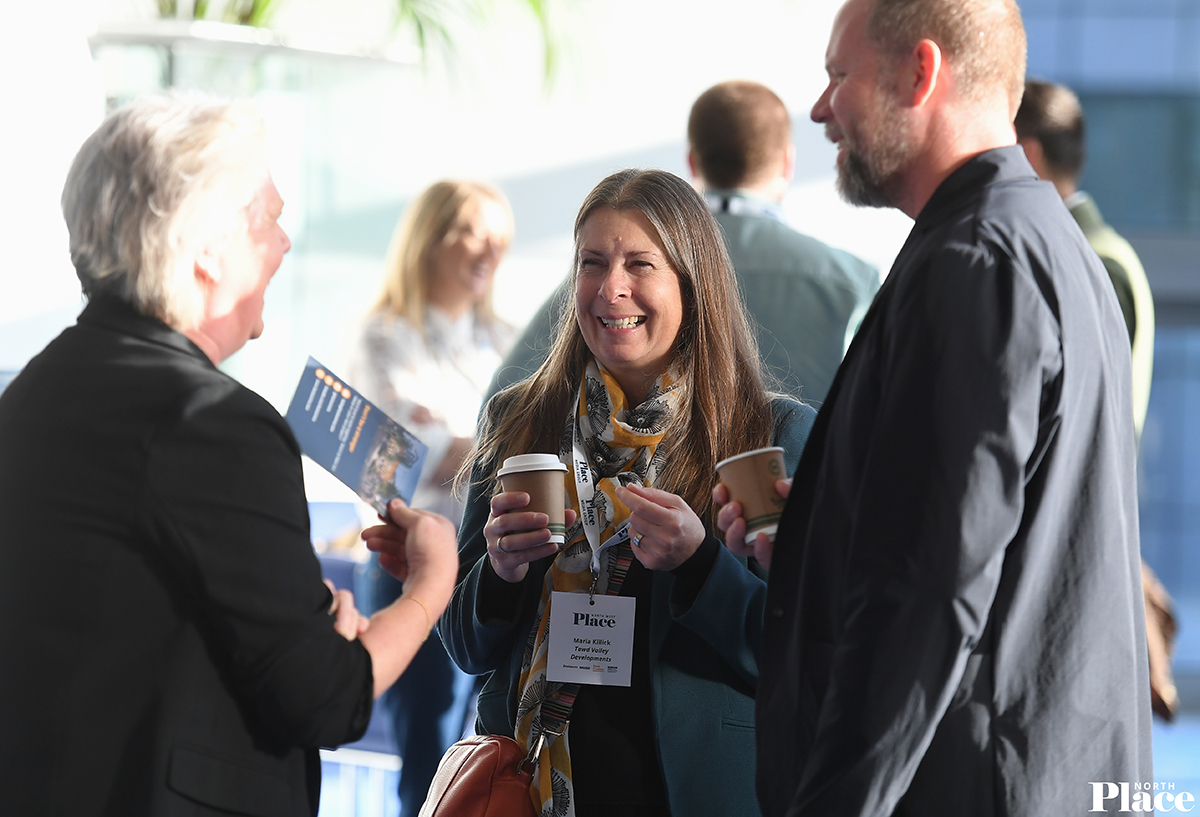
Attendees at Place North’s Revitalising our Town and City Centres conference at the Bridgewater Hall in Manchester also heard from Allied London chief executive Mike Ingall about his experience creating Spinningfields out of a derelict and unsafe part of Manchester.
The third and final part of the conference pulled together the themes of the day, asking a panel of urban designers and place experts to share their tips on what placemaking should look like in a 2026 context, citing best practice from around the globe.
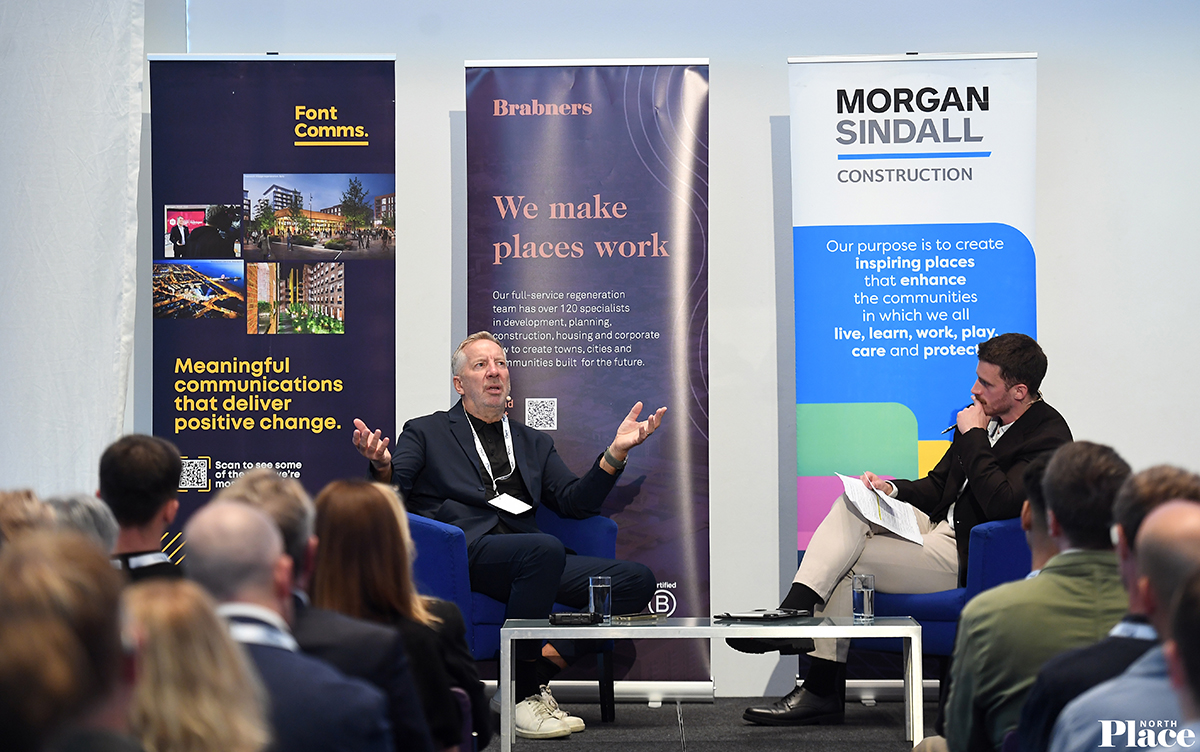
The event was supported by Brabners, Muse, Font Comms, and Morgan Sindall Construction.

Expert speakers
- Mike Ingall, chief executive, Allied London
- Gillian Osgerby, programme director, Hull City Council
- Matt O’Neill, executive director of place, Barnsley Council
- Stephen Watson, executive director, Sefton Council
- Tom Jonson, director of landscape architecture, LUC
- Steve Burns, major projects manager, Tameside Council
- Pete Swift, chief executive, Planit
- Becca Eatwell, founder, Font Communications
- Chithra Marsh, director, Buttress Architects
- Jon Humphreys, co-owner and creative director, Sheila Bird Studio
- Laura Percy, development director, Muse

Is it time we retired the term ‘placemaking’? That was the question debated by panelists. Credit: PNW
A Spinningfields yarn
Almost a decade since the last building at Spinningfields completed, Allied London’s Mike Ingall regaled the audience with the tale of how the £1.5bn development spawned from an idea to a pioneering part of Manchester.
“It was just after the bomb, and their mind was full of the bomb. But they’d started to invent the word regeneration,” Ingall said of an early meeting with the city council.
Comprising 4.5m sq ft of office, retail, and leisure space, Spinningfields became both an extension of Manchester’s business district and a new quarter in its own right.
Ingall said the idea was to broaden the city’s employment base by creating modern offices with large floorplates that would appeal to financial and professional services companies looking to plant a flag in Manchester.

Mike Ingall in full flow. Credit: PNW
“We would never have started Spinningfields if we couldn’t readily identify the employment market,” he said, pointing to Canary Wharf in London, which had wooed the banking sector, as an example of how it had been done before.
“We decided that we were going to attack the financial and professional services market and provide buildings and a place and infrastructure where people could rebrand [and] collocate. Then we got RBS, 8000 people [and c.500,000 sq ft of floorspace].”
Ingall’s point about a place having a specific purpose is still relevant today. Places that can hang their hat on a differentiator are the ones that will succeed in the post-retail world, he said.
“You’ve only got to look at most high streets and most towns that went on the glory hunt for a shopping mall in the 90s or 80s,” he said.
“It’s an inward-looking development. It’s probably failed. The town has lost its identity.”
Lightning talks – the difference approaches to revitalisation
Hull
The £70m regeneration programme focusing on the port city’s heritage assets and maritime history has succeeded in boosting Hull’s profile and visitor numbers.
“Hull Maritime is a celebration of 800 years of Hull’s history,” said Gill Osgerby, who led the project for the council.
“It celebrates the city and its people. It’s fair to say, over the recent decades, that Hull had forgotten its identity, and we had turned our backs on the sea. And this is something that this project wanted to tackle.”
The project featured the refurbishment and reopening of Hull’s Maritime museum, described by Osgerby as “the jewel” in Hull’s crown.
Taking a heritage-led approach to regeneration has resulted in Hull being named as the only British city on National Geographic’s best places to visit in the world in 2026. Other cities on that list included Beijing, Manila, and Quebec.

Gill Osgerby explains how Hull came to be one of the world’s best visitor destinations, according to National Geographic. Credit: PNW
Barnsley
Matt O’Neill, executive director of place at Barnsley Council, outlined how Barnsley had and is continuing to build a place that “makes sense for its residents” after the post industrial decline of the 1980s.
“We went from full employment to no employment overnight…so this is a renaissance,” he said.
Barnsley’s town centre has been reimagined following the decline of high street retail around experience, leisure, and health.
The Yorkshire town, equidistant between Leeds and Sheffield, is also recognised by government as the UK’s first tech town.
This means that Barnsley is regularly used as a test-bed for new technologies and that residents will be equipped with AI training. Meanwhile, plans for a National Centre for Digital Technologies is in the works, O’Neill said.

From post-industrial decline to tech town, Barnsley’s rise has been meteoric. Credit: PNW
Sefton
Sefton Council has its hands full when it comes to regeneration, with large projects in Southport and Bootle underway.
In Southport, the council wants to deliver a £100m+ exhibition complex to attract large events and 500,000 visitors to the seaside town annually. The hope is that the development will act as a catalyst for further investment, according to Stephen Watson, executive director at Sefton Council.
In Bootle, the focus is on transforming the Strand shopping centre, which the council owns, into an asset that meets the needs of modern consumers and addresses, in part, the town’s challenges.
“We’re talking about one of the most deprived towns in the whole country,” Watson said. “Life expectancy here is 12 years less than it is in Formby, less than 12 miles away.”
“We get nothing but support for all of this ambition in Bootle. The only thing we get is pressure. We’ve got to deliver this.”

Both Southport and Bootle are being transformed, Watson explained. Credit: PNW
Tameside
In Ashton and Stalybridge, the council and Greater Manchester Combined Authority are seeking to deliver a “national exemplar of transport-led regeneration”, said Steve Burns, major projects manager at Tameside Council.
The idea is to leverage the area’s 13 rail stations – including Ashton, Stalybridge, Guide Bridge, and Denton – to deliver homes and workspace connected via a “frictionless integrated transport system”, he said.
“The transport is the enabler for the development. We’ve got a huge development pipeline already established in Ashton and Stalybridge.”

Could transport be the key to unlocking regeneration in Tameside? Steve Burns explains. Credit: PNW
A word for nature
Ireland’s 2040 strategy is seeing €250bn invested across the country to prepare it for an additional 1m residents. Part of the focus is on enhancing public realm and improving existing green spaces, explained Tom Jonson, director at landscape consultancy LUC.
In part, the funding is coming from windfall taxes on large technology corporations including Meta and Google, as well as proceeds from Apple, which was ordered to pay €13bn of taxes to the Irish government in 2024.
Climate resilience is a key tenet of the 2040 strategy; the Irish government has recognised the need to be more prepared for extreme weather in the future. Part of LUC’s work is to create spaces that are capable of dealing with storms and lessening their impact on the surrounding environment by including nature-based solutions such as rain gardens.

Money from big tech is improving Ireland’s climate resilience, Tom Jonson said. Credit: PNW
What is placemaking?
Should we retire the word ‘placemaking’? That was the essay question speakers on the event’s closing panel were asked to grapple with.
They conceded that the word had lost its impact through overuse and said that the onus is on the development industry to communicate more plainly to stakeholders about the whats, whys and hows of a project
“I don’t think it’s about creating a new word for [placemaking],” said Jon Humphreys, co-owner of Sheila Bird Studio.
“I think it’s about understanding the complexity of what placemaking is and what are the barriers to entry.”
Chithra Marsh, director at Buttress, agreed. “That word just is a catch-all for me,” she said.
“I think it’s about how you approach it. It’s all about the approach, whether it’s co-design or if it’s financially-led or purely community-led. There are so many different levels to it.”
Becca Eatwell, founder of Font Communications, said taking a holistic approach to development is a non-negotiable. That includes factoring in some of a scheme’s more mundane elements like parking.
“We can’t forget that for the people that these places are being created for it’s about what it means to them on a day-to-day basis,” she said.

The panel said Stockport was a good example of modern day placemaking success. Credit: PNW
The industry’s role when it comes to redevelopment should be about “growing or shaping” a place and building on its history, rather than “making” a new one, said Pete Swift, chief executive of Planit.
“Nowhere is made from scratch,” he said. “There’s no such thing as a non-place. Even if you’re in the middle of the Atacama Desert, it’s a place. It’s got heritage. It’s got stories. It’s got people.”
Laura Percy, development director at Muse, warned against the temptation to take a formulaic approach to development. What works in one place might not necessarily work in another, she said.
“Look at a place like Barrow, typified by long-term cycles of boom and bust [and] chronic underinvestment.
“What they don’t need is new replicated houses for people coming in from the outside. What they need is to be reconnected back to what’s already there.”
What next?
1 October – Place Party
15 October – Yorkshire Industrial & Logistics
20 October – Place RESI
5 November – Liverpool City Region Development Update
19 November – Life Sciences Update
2 December – Economic Forecast Lunch: The North in 2027
Gallery
Click any image to launch gallery